Rare Elvis Presley interview -excerpts in regards to Valentines Day

ImageImageImageImage


JEFF SCHREMBS – ALL RIGHTS RESERVED 2014


How Elvis Presley birthplace became a historical landmark

If there is one person most responsible, other than Elvis, creating the Elvis Presley Birthplace Park in Tupelo, it is Oleta Grimes who was the daughter of Orville Bean who helped Vernon build the home Elvis was born in.

Previously Elvis donated money to the City of Tupelo to create a children’s playground around his birth home. Over a period of time the city park evolved into the centerpiece of Tupelo’s tourism.  The house is now one of the most visited attractions in the state of Mississippi.

Without the help, and dedication of, Mrs. Grimes this park may not have been created. Here are the facts.
All of this land once belonged to Mrs. Grimes’s father, Orville Bean.

The Presley family were among the sharecroppers on Bean’s dairy and cotton farm. After marrying Gladys Smith, Vernon Presley borrowed money from Mr. Bean to build this dwelling, next to his parents’ house.

On January 8, 1935 Gladys Presley gave birth to twin boys at home; Jesse Garon who was still born, and Elvis Aron.  Young Elvis lived in this house only three years.
Mr. Bean had, and remains to have, the reputation of being; a harsh man (i.e. the story concerning Vernon and his brothers and a true case of redemption), ruthless at business, shrewd, but also had the ability (on certain matters) to be able to forgive and to help members of the community (as he did to the Presley family concerning Elvis birthplace).

His daughter Oleta Grimes was known to have a good heart, be a good neighbor, and a loving and caring member of the community, In fact she became the fifth grade teacher at the community school, East Tupelo Consolidated.

In 1945 Elvis and Shirley Gillentine were chosen to represent their school in the Mississippi-Alabama talent show a fact that Gladys Presley did not know until after Elvis returned home that same day.

Shirley won first prize, Elvis placed fifth and the photograph of Elvis standing on stage, blonde hair and glasses, is essential to Elvis’ story and gives us some insight into the Presley family (please see the photograph contained in this website). Three years later, Elvis moved to Memphis with his mother and father.
In 1956, the Presley family returned during the annual fair to a parade and a sold out concert featuring the now “worldwide talent”…Elvis Presley.

To rise from severe poverty to worldwide fame in these 11 years is truly an original American Story. .

This day was deemed “Welcome Home Elvis Day” where Elvis performed at the same fairground in front of 14,000 people (a crowd larger than the population of the town) wearing a velvet shirt customized for Elvis and given to him by Natalie Wood.

When Orville Bean died and Oleta Grimes inherited his property. And here is where the story of the Birthplace Park begins.

At the Birthplace Park today the story is usually told that Elvis happened to drive past the land of his birth, during his drive to his hometown for the “Welcome Home Elvis Day” and noticed a ‘for sale’ sign.

Elvis was visibly moved and we walked the grounds, peeked into the windows, and then sat upon the step while wiping tears away recalling all his family had gone through and the fact that his twin brother had died during delivery (i.e. stillborn).

As Elvis was being reminded that “we have to go” Elvis decided to buy it and create the park. But the 1957 Fair show was billed as a benefit show for the “Elvis Presley Youth Center” to be built on the land.

Elvis donated his performance fee to buy the land. Elvis did like to visit the old neighborhood. Oleta recalled with fondness that Elvis would visit her husband’s store and their home. At any rate, she sold the land to the city of Tupelo with the intent to create the park.


The first step was to clear the land of the assorted outbuildings and homes on the park property, except for the one that Elvis was born in.

Some people have said that the city “got in wrong” and tore down Elvis’ birthplace. For whatever reason(s) they want you to believe that tourists now visit a replacement house.

The facts are that Gladys Presley was present during the 1957 events along with many of Gladys’ friends and female relatives along with Oleta Grimes. Hence, they did not mistake which house Gladys gave birth to her twin sons.
Eventually the city government did build something close to what Elvis wanted; an indoor recreation hall, a baseball diamond, a swimming pool and a playground. The little house sat unused from 1957 until 1971.

That year the East Tupelo Garden Club, including Oleta Grimes, took it upon themselves to restore the house. Interestingly if you look at the oldest known photo of Elvis birthplace, compared with the “restored photos”, you will notice several things. Among them are; the house itself was physically relocated, there was no swing, and there were handrails to the three steps.

Kindly, Vernon helped them and even gave them a felt hat to place upon the mantle. Elvis knew of these efforts but took no role in part because his beloved mother, Gladys Love (Smith) Presley, had died approximately one year after the initial dedication and his heart was forever broken.

Yet, on several occasions he would come down at night to look around carrying his infamous black police flashlight. Often he was speechless and his emotions varied and his bond was evident.
By now thousands toured the Birthplace Park.  Fan Appreciation Day had become a media event for Tupelo. Oleta was not the leader of this event for Janelle McComb was (note: Janelle would become a close friend of Elvis’ and even wrote a poem, for a gift from Elvis to Lisa Marie, that; Elvis loved, made tears come to his eyes, and he proudly gave to Lisa Marie (and remains a cherished possession of Lisa Marie – as it should be).

She had the assertiveness and political skills to turn the Birthplace Park from a part time effort into a tourism destination.

Someone like Janelle was needed to do that, but at the same time she did not share attention easily Oleta Grimes was near the end of her life when that photo was taken, she lived to be one hundred.

She did very few interviews, never asked for the spotlight. That’s too bad, she was too quiet. She had a lot of stories to tell.


Part of the money raised from the banquet and shows (Elvis would do two shows at Ellis Auditorium) was given to the Elvis Presley Foundation. The Foundation had the responsibility to create a park on the land adjacent to his birthplace.
The Elvis Presley Birthplace Foundation and the city of Tupelo share responsibility for maintenance and operations of the Birthplace Park.


We encourage everyone, when they have a chance, to visit this wonderful landmark as well as; visit Graceland, go to www.Elvis.com (the official Elvis Presley website), and support the endeavors of Lisa Marie – her husband – and their family.


Elvis Presley & Hurt 1976 live onstage audio

There is no doubt that Elvis had been “hurt” during his lifetime and every day since his beloved mother died on August 14, 1958 – when his marriage deteriorated in the early 1970s – and when he health (mentally and physically) deteriorated, along with his outlook on life and his career, over his declining depression and weight gains.

The song “Hurt” was a song that Elvis loved but it was bittersweet for him. He admired the arrangement as well as the vocal challenges (as the song required a 3 octave rang with a crescendo at the end lasting a good 30+ seconds).

Throughout 1976 and 1977 Elvis sang this song during those concerts when he was “up” (meaning happy and focused). On other shows in which his depression, monetary pressures, being upset about the book entitled “Elvis what happened?” was being written and/or published, and the constant negative press reviews about his weight.

Elvis was a proud man who took great strides to look his best. In fact, according to those who knew him the best, there were only a few times, over a few decades, in which Elvis (even at Graceland) was not groomed and/or dressed to the “9s”.

The one time, at Graceland in 1976, is my favorite as Elvis, who had severe insomnia = chronic sleepwalker – sleep apnea (since childhood), had been in his room for several days with his meals being put outside his door and the earlier dishes and glasses left outside the door when done.

Usually Elvis came down the stairs at Graceland, after first calling down from his private phone in his room to let one of the Memphis Mafia know he was up and to pass along his meal request, in the early to mid afternoon.

Everyone stated that they “knew” when Elvis was coming way before they saw him as there was an energy about Elvis that transformed/dominated every setting. Well on this specific day Elvis came downstairs in his robe, unshaven, and his hair was almost completely white (as he dyed his hair black dating back to 1956 and continued to do so for cosmetic reasons and because he had gone prematurely white) and he got to the foot of the stairs and everyone looked at him and, kept their amusement to themselves, Elvis looked around and said “{curse word} it – I’m going back upstairs” as he was embarrassed.

A few hours later Elvis returned, dressed up with freshly dyed hair and attitude, and repeated his standing at the bottom of the steps looking around. He asked “do you {curse words} like me now?” at which point he started to laugh and everyone laughed with him. He then said “the next time I come down looking like Charlie Rich (a singer he respected but also had gone completely white haired prematurely but refused to dye it) one of you {another curse words} remind me.  Elvis had a wicked sense of humor and his laugh was not only one of sheer happiness but it also was contagious.

There are several great recordings of Elvis’ singing Hurt including the one released on his albums. The CBS Elvis Special, taped a few months before he died on August 16, 1977 but aired after his death, contains one of the greatest (vocal) versions of Hurt yet, for me, it is bittersweet as it is clear (and was clear at the time) that Elvis’ health was grave and he should have been hospitalized instead of performing but if you listen to him singing Hurt it is (literally) an amazing vocal accomplishment with Elvis easily obtaining a 3 and 1/2 octave range. I love that version but yet am reminded (sadly) of his health and his death.

So, thanks to YouTube I now share Elvis Presley singing Hurt from his live concert in Pittsburgh in 1976 (audio only). Enjoy.

Elvis Presleys birthday is January 8th 2014 (by Jeff Schrembs)

In a few days, on January 8, 2014, Elvis Presley would have been 79 years old.

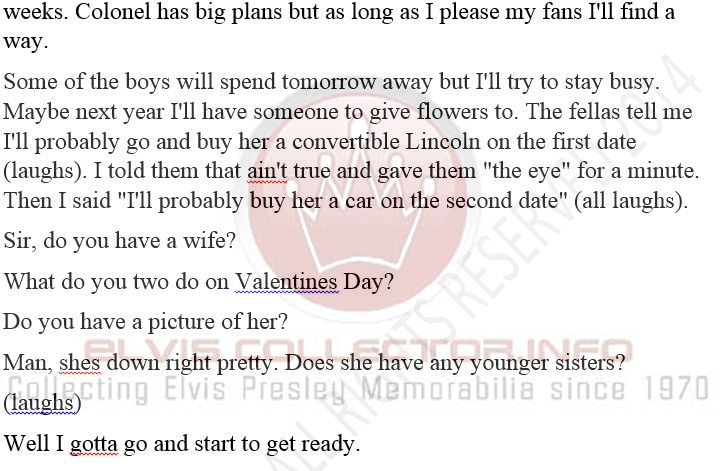
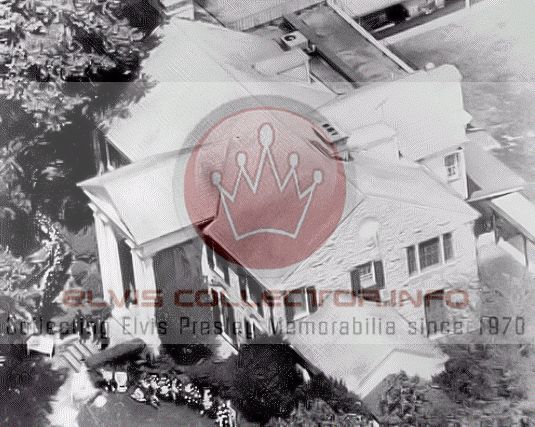
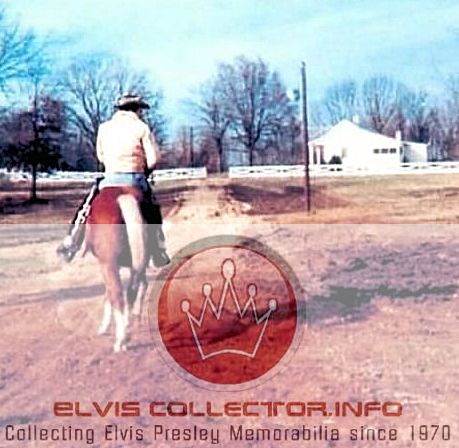
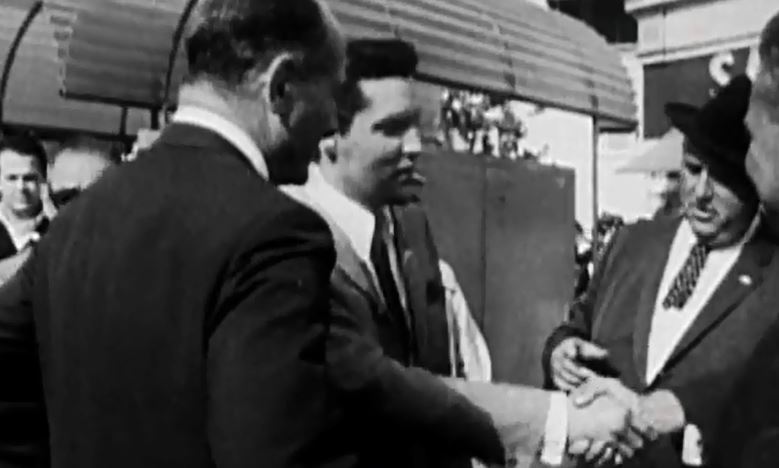
Here are a few rare photographs of Elvis throughout the years.


WM GRACELAND view from helicopter WM HORSEBACK from back in 67 wondreful WM RARE 1955 caddy floorboards EP Worlds Fair Colonel with Elvis

For additional photos please check out http://www.ElvisCollector.info.

Take care and may God bless you.

Elvis Presley’s lineage

Elvis’s great-great-great-grandmother, Morning White Dove (1800-1835), was a full-blooded Cherokee Indian. She married William Mansell, a settler in western Tennessee, in 1818. William’s father, Richard Mansell, had been a soldier in the Revolutionary War. Mansell is a French name–its literal translation is the man from Le Mans.

The Mansell’s migrated from Norman France to Scotland, and then later to Ireland. In the 18th century the family came to the American Colonies. The appellation “white” in Morning Dove’s name refers to her status as a friendly Indian. Early American settlers called peaceable Indians “white,” while “red” was the designation for warring Indians or those who sided with the British in the Revolutionary War. It was common for male settlers in the West to marry “white” Indians as there was a scarcity of females on the American frontier.

Like many young men in the American Southwest, William Mansell fought with Andrew Jackson in the Indian Wars of the early nineteenth century. He fought with Old Hickory in Alabama, at the Battle of Horseshoe Bend, and later in Florida too. Returning to Tennessee from the Indian Wars, William Mansell married Morning White Dove. Elaine Dundy says of the marriage, he (William Mansell) gained “age-old Indian knowledge of the American terrain; of forests and parries; of crops and game; of protection against the climate; of medicine lore, healing plants as well as something in which the Indians were expert–the setting of broken bones.” Moreover, added to Elvis’s lineage were Morning White Dove’s ruddy Indian complexion and fine line of cheek.

Like many other settlers, the newlyweds migrated to Alabama from Tennessee to claim lands garnered in the Indian Wars. The Mansell’s settled in Marion County in northeast Alabama near the Mississippi border. The Scots-Irish, like William Mansell, were the predominant settlers of Alabama. One-tenth of the population in colonial America was Scots-Irish at the time of the American Revolution.

And a very interesting group they were. The Anglican Reverend Woodmason had this to say about the Scots-Irish women of William Mansell’s day. “They wore nothing but thin shifts and a thin petticoat underneath. They are sensual and promiscuous. They draw their shift as tight as possible to the body, and pin it close, to show the roundness of their breasts, and slender waists (for they are generally fined shaped) and draw their petticoat close to their hips to show the fineness of their limbs–so that they might as well be in puri naturalibus.”

The Scots-Irish in America were a passionate community living close to the earth. They disdained the niceties of their British neighbors. Of this Reverend Woodmason had to say,” they delight in their present low, lazy, sluttish, heathenish, hellish life, and seem not desirous of changing it. These people despise knowledge, and instead of honoring a learned person…they despise and ill-treat them…”

There were other views on the passionate lifestyle of the Scots-Irish, however. James Hall of Philadelphia described a young, Scots-Irish frontiersman in this way. “He strode among us with the step of Achilles…I thought I could see in that man, one of the progenitors of an unconquerable race; his face presented the traces of a spirit quick to resent–he had the will to dare, and the power to execute, there was something in his look which bespoke a disdain of control, and an absence of constraint in all his movements indicating an habitual independence of thought and action.”

Think of Elvis in these words: the will to dare and the power to execute, a disdain of control in all his movements indicating a habitual independence of thought and action. This is the Scots-Irish heritage from which Elvis Presley issued. In his genes he carried an independence of blood, the will to dare and the power to execute. Many influences formed Elvis Presley besides the genealogical, yet this description has a haunting accuracy. Morning White Dove and William Mansell prospered in Alabama.

Their land was fertile and they built a substantial house near the town of Hamilton. They had three offspring, the eldest of who was John Mansell, born in 1828, and Elvis’s great-great grandfather. Elaine Dundy has this to say of John Mansell. He was “half Scots-Irish, half Indian, (but) seems to have grown up wholly “wild Injun.” Although by the time he was twenty-two he had married Elizabeth “Betsy” Gilmore and they would have some nine or ten children together, “settling down” can hardly be the phrase for what he was devoting his life to. John was one of those sexually overactive men who seem intent on populating the universe with children. Both his legitimate and illegitimate descendants still abound in northwest Alabama and in
northeast Mississippi.”

John Mansell squandered the legacy of the family farm. In 1880 he abdicated to Oxford, Mississippi, changing his name to Colonel Lee Mansell. His sons left Hamilton to seek their fortunes in the town of Saltillo, Mississippi, near Tupelo, the birth place of Elvis Presley. The third of John Mansell’s sons, White Mansell, became the patriarch of the family with John Mansell’s removal to Oxford. White Mansell was Elvis’s great-grandfather. White Mansell married Martha Tackett, a neighbor in Saltillo.

Of note is the religion, Jewish, of Martha’s mother, Nancy Tackett. It was unusual to find a Jewish settler in Mississippi during this time. All accounts point to White Mansell as a hard-working, upright, provider for a clan increasingly besieged by economic factors beyond their control. The Civil War fractured the Southern economy and soul. Cotton, the backbone of the South, was subject to financial depressions such as the Panic of 1890. Additionally, the deep South suffered numerous outbreaks of yellow fever during the mid-nineteenth century. Add to this the extraordinary number of fatalities suffered in not only the Civil War but also the Mexican War, and the devastation of Southern culture in the nineteenth century was complete. Like many other Southern families, the Mansells were stretched to the breaking point. They sold their lands and became sharecroppers. The prosperity of the South, along with the fortunes of the family, had plummet.

However the life of a sharecropper was not unremittingly grim. They had music and dancing and the comfort of religion. Tenant farmers, sharecroppers, were often invited to the owner’s house on Saturday nights for square dancing and parties. Sundays there were picnics on the ground after church. Although there was little hope of escaping poverty, it was a life of community with some gayety. Enter now Doll Mansell, Gladys Presley’s mother and Elvis’s grandmother, of whom Elaine Dundy had this to say. “And the gayest of all the girls at these gatherings, the acknowledged beauty, was the slim, exquisite, tubercular, porcelainfeatured, spoiled third daughter of White Mansell…Doll.” She was a delicate beauty and the apple of her father’s eye. She did not marry until twenty-seven, and then to her first cousin, Robert Smith.

Bob Smith was the son of White Mansell’s sister, Ann. Ann Mansell was a striking woman of dignity and stature, a commanding presence until her death at eighty-six. Bob Smith and Doll Mansell, Elvis Presley’s maternal grandparents, were first cousins. This was a genetic intensification, a doubling, of the family lineage. The marrying of first cousins, with its intensities and possibility for dysfunction, was common in insulated communities of the agrarian South. Like Doll, Bob Smith was very handsome, his Indian blood evidenced in a noble brow, good bone structure, even features and dark, deep-set eyes. His black hair was dark as coal.

Doll would be bedridden from tuberculosis throughout the marriage. Like his uncle and father-in-law, White Mansell, Bob Smith labored long and hard as a sharecropper, and occasional moonshiner, to support his invalid wife and eight children. The noose of poverty tightened on the family, and on Elvis’s mother, Gladys.

Elaine Dundy: “Genetically speaking, what produced Elvis is quite a mixture. At the beginning, to French Norman blood was added Scots-Irish blood. And when you then add to these the Indian strain supplying the mystery and the Jewish strain supplying spectacular showmanship, and you overlay all this with his circumstances, social conditioning, and religious upbringing–specifically his Southern poor white, First Assembly of God upbringing–you have the enigma that was Elvis.”

Less is known of Elvis’s paternal heritage through his father, Vernon. The first Pressley in America was an Anglo-Irishman, David Pressley, who settled with his son, Andrew Pressley, Senior, at New Bern, North Carolina in 1740. Not until the third generation is there significant historical record of the Pressleys, beginning with Andrew Pressley, Junior.

Andrew fought in the last major battle of the Revolutionary War in the South, the Battle of Eutah Springs, South Carolina, 1781. The history of the Presleys picks up again with Dunnan Pressley, Junior, in the middle of the 19th century. Dunnan married Martha Jane Wesson at Fulton,
Mississippi, the seat of Itawamba County, in 1861. Like many others, Dunnan was probably drawn to the region by cheap land offered to veterans of the Mexican War. In those days richly timbered acreage went for twenty-five cents an acre. Dunnan and Jane had two daughters, Rosalinda and Rosella, Elvis’s great-grandmother.

The Civil War broke out and Dunnan joined the Confederate Army–twice! On each enlistment he collected a three hundred dollar bounty for his horse, and each time he quickly deserted his regimen. Having twice deserted honor and duty with the Confederacy, Dunnan next abandoned his wife and two daughters. Mrs. Robie Stacy, his granddaughter, had this to about it. “My mother told me that when she and her sister were just little babies, their grandparents had taken them to church one Sunday and when they came back, their father, Dunnan, was gone. He went back to his other wife and child.” Apparently bigamy can be added to Dunnan’s character defects.

Dunnan Presley’s daughter, Rosella, internalized the abandonment and re-enacted it throughout her life. Beginning at age nineteen and continuing over 28 years, Rosella bore nine illegitimate children, never once identifying her lovers or making any claim on them. The children never knew of their fathers as Rosella stubbornly, and resourcefully, supported them through sharecropping. Mrs. Doshia Steele, one of Rosella’s daughters, said this of her plight. “I can’t remember anyone ever talking about who our father was…It was a big mystery when we were children. My mother just didn’t talk about it.”

Elvis’s paternal line continued through Rosella’s son, Jessie Dee Presley (1896-1973), Elvis’s grandfather. As would be expected, J.D. Presley re-enacted his father abandonment by making weak bonds with his own children. His brother, Calhoun Presley, had this to say about J.D. “For most of his life Jessie drifted from one job to another all over Mississippi, Kentucky, and Missouri. He was a sharecropper in the summer and a lumberjack in the winter.

Jessie worked hard and played hard. He was an honest man, but he enjoyed drinking whiskey and was often involved in drunken bar brawls. As a result, Jessie spent many a night sobering up in jail. He was a slim, handsome man about six feet tall with black hair. I reckon Elvis inherited his looks from Jessie. He was also a dapper dresser. Clothes were one the most important things in his life. We used to call him “the lawyer” because he dressed so smart. He loved fine clothes. His favorite suit was a tailor-made brown one with pearl buttons.

He saved up for months until he had enough money to buy it–twenty-four dollars. He paraded around town like a peacock, with his head in the air and a cane in his hand. Owning expensive clothes was his only ambition in life. He hated poverty and he didn’t want people to know he was poor. He felt that if he wore a tailor-made suit, people would look up to him.” In 1913 J.D. married Minnie Mae Hood, “Grandma Dodger,” who was to live with Elvis throughout his adult life. In 1916 their first child was born, Vernon Presley, Elvis Presley’s father.

It was toward Vernon that much of Jessie’s abandoning was directed. Vernon was scared of J.D., any transgression of his father’s rules could provoke a beating. This, combined with Jessie’s drunken and philandering ways, caused permanent harm to their relationship. In many respects it was as if Vernon had no father as Jessie repeated his own father abandonment on his children. This theme of father abandonment reverberates throughout Elvis’s paternal lineage. It is a strong clue to the abandonment that Elvis felt, and perpetrated, in his own life.

Fun facts about Elvis Presley Christmas Albums

Elvis. Elvis Presley. No matter which name you use 99.9% of the public will know of who you speak. When it comes to Elvis collecting I have written about the “in’s and out’s” for decades. I encourage you to seek out my blogs and to visit www.ElvisCollector.info. However, when it comes to Elvis and Christmas (his favorite holiday) the two go together like…Elvis and Christmas. There are a few collectibles, pertaining to Elvis and Christmas, that every collector should have as these were issued during his lifetime (i.e. January 8, 1935 through August 16, 1977). The first is to own each of his Christmas Albums and by the magic of this blog…here they are (note the following stats are correct but the author is unknown):

1957 Elvis ´Christmas album LOC-1035 / Usa   # 1      Released in the US October 1957 Original United States  and available through 1959. It is widely recognized as the best Elvis and RCA venture. When the record was released in a single pocket sleeve with a different cover.(see also lpm-1951 pictured below).. It was the last Elvis Presley album released before Elvis left for his service in the US Army.


1959 Elvis ´Christmas album LPM-1958 / Usa was reissued in 1957 with alternate picture cover.   1970 Elvis ´Christmas album United States version charted in Billboard: Usa  #1

.

1970 Elvis ´ Christmas album cas-2426 / Usa (reissue 1975) This album was reissued in 1975 on the record label “Pickwick”

1971 Elvis sings the wonderful world of Christmas anl1-1936 / Usa charted to # 2. 

Wishing all Vets a happy Veterans Day 2013

We, individually and collectively, can never do enough for those who served in the military and do so now.

They, and their family and loved ones, make sacrifices (in public and in private) that we can never fully grasp.

Thus on this day, and each day thereafter, we want to say to the Veterans and their family THANK YOU and may God bless you.

Jeff Schrembs

Elvis Presley family lineage

Elvis Presley was born on January 8, 1935, in Tupelo, Mississippi to Vernon Elvis Presley, and Gladys Love Presley (Smith was her maiden name), in the two-room shotgun hWM Elvis Family Tree Elvis Presley was born in Tupelo Mississippi, on January 8, 1935 having been delivered by the local doctor via a “house call” (i.e. the physician came to the home as opposed to a hospital) . This home was built by Vernon Presley, Elvis father, in the type of home known, in the south, as a “shotgun house” which meant that if you were to shoot a shotgun standing in the front door it would go all the way through the house without hitting anything else while passing through the back door (I.e. there were no walls other than the 4 exterior walls). Jesse Garon Presley, who was Elvis identical twin brother, was delivered (approximately) 35 minutes before him, (sadly) stillborn.

As an only child, Elvis became close to both parents and formed an unusually tight bond with his mother. The family attended an Assembly of God church where he found an outlet for his  musical inclinations.

Johannes Valentin Bressler,   the founder of the Presley family in America, was born in the   Palatinate, Germany, 1669 in the village of Hochstadt (where the Preslar family   was first mentioned in 1494); Valentine was employed there as a vine dresser; he   married Anna Christiana Franse (Born Germany 1674) and immigrated to New York in 1710; with some French Norman; one of Gladys’ great-great-grandmothers was Cherokee Indian and, according to family accounts, one of her great-grandmothers was Jewish. Gladys was regarded by relatives and friends as the dominant member of the small family.

Elvis Presley descended from the Bressler (Presley) line, the name being Americanized down the line, first into Preslar, then Pressley and finally Presley but only because  his Great Grand Mother, Rosella Pressley adopted her maiden name for her children. She never did tell any of her children who their father was.

Rosella bore nine ‘illegitimate’ children, never once identifying to her   children who their fathers were. Rosella stubbornly, and resourcefully,   supported them through sharecropping. Mrs. Doshia Steele, one of Rosella’s   daughters, said this of her plight. ‘I can’t remember anyone ever talking about   who our father was, It was a big mystery when we were children. My mother   just didn’t talk about it’. Rosella, internalized the abandonment and re-enacted   it throughout her life. Beginning at age nineteen and continuing over 28   years.

Rosella’s son, Jessie D. McDowell   (J.D.) Pressley (1896-1973) was Elvis’   Grand Father. He was born on April 9, 1896 in Itawamba County,   Mississippi, to Rosella Presley, unmarried, and John Wallace (Elvis’ great-grandfather). So though the rightful   (traditional) surname would have been Wallace, Rosella gave her children her   own name, her maiden name of Presley.

Elvis Grandfather, Jessie, J.D. Presley used the double ‘s’ before changing to the single ‘s’ after his great grandson attained international fame.

October 9, 1973 Elvis’ divorce was final (by Jeff Schrembs)

Starting from the first time Elvis met Priscilla, while Elvis was in the US Army stationed in Germany and Priscilla was there with her family with her Father who was in actuality her step father a fact that was kept from her, there was an immediate mutual attraction.

Note –  Priscilla’s biological father was US Navy pilot James Wagner. His parents were Kathryn and Harold Wagner. On 10 August 1944, at the age of 23, he married Priscilla’s mother; they had been dating for more than three years.  He was killed in a plane crash while returning home on leave when Priscilla was six months old. When Priscilla discovered this “..family secret…” while rummaging through an old wooden box of family keepsakes, she was encouraged by her mother to keep it from the other children as she feared it would endanger our family closeness. In 1948 her mother met a United States Air Force officer named Paul Beaulieu, from Quebec. The couple were married within a year. Beaulieu took over the raising of Priscilla and was the only father Priscilla would ever know

Though Elvis only met Priscilla a few months before being honorably discharged from the US Army, in March of 1960, and Priscilla was only 14 years old at the time (a fact that was contrary to her; looks, demeanor, maturity, outspokenness, and her outlook on life) Elvis had a deep caring for Priscilla that would eventually be consummated in their marriage on May 1, 1967.

Elvis and Priscilla, through mutual shortcomings and actions adverse to the marital vows they took, (sadly) split up in  1972 and formally divorced with the final divorce decree issued on October 9, 1973.

The property settlement agreement, dated  August 15, 1972, was between Elvis Aaron Presley and Priscilla Ann  Presley.

It stated the couple had agreed to split the  property to avoid further legal costs.

It reads: ‘The parties were married on May 1,  1967 in Las Vegas, Nevada.

‘Unfortunate circumstances and unhappy  differences have arisen between the parties  by reason of which they have lived  separate and apart since February 23, 1972, and by reason of which they intend  to dissolve their marriage.

‘By this property settlement the parties wish  to avoid unnecessary  litigation and the emotional stress and expense which  would accompany.’

Some of the interesting details of their divorce settlement are as follows:

Elvis signed over ownership of three of his prized possessions – a 1971  Mercedes-Benz car, a 1969 Cadillac El Dorado and a 1971 Harley Davidson  motorbike.

Priscilla had originally agreed to a cash  settlement that was 7.5 times less than the amount she finally  received.

She signed the paperwork that confirmed she  would receive a $100,000 tax-free lump-sum payment.

The official document is at odds with the  $750,000 payment she eventually received after she appointed new lawyers who  advised her to seek more money.

As well as Elvis’ cars and cash, actress  Priscilla also stood to receive half the income from the sale of their three  properties in California.

‘The agreement granted Priscilla ownership of  a 1971 Mercedes Benz, a 1969 Cadillac El Dorado, a 1971 Harley-Davidson  motorcycle, $100,000 in cash, and half the income from the sale of their three  houses in California.

‘It is initialed in ink by Elvis and  Priscilla on page three and signed by them on page nine.

‘The supplement specifies that taxes applied  to the cash would be paid by Elvis.’

Here are two copies of the actual divorce proceedings

Initialled: Elvis agrees to give Priscilla two luxury cars, a motorbike and $100,000

.Binding: As well as Elvis' cars and cash, actress Priscilla also stood to receive half the income from the sale of their three properties in California

Elvis’ divorce adversely effected him throughout the remainder of his life. Though he was blessed with the birth of his daughter, who he truly loved with all his heart being Lisa Marie born exactly nine months after the wedding, the reality that his marriage had ended contributed to his failing health which included mental, emotional, and addictive behavior.

Elvis Presley endured his triumphs, and his failures, in the public eye. Fortunately, for us and for Elvis, he had an outlet to share his feelings…and his soul being his singing and performing.

During the 1970s Elvis recorded several poignant songs that, to this very day, resonate as they apply to those going through separation, divorce, children of divorce, etc. This include, but are not limited to, these songs; Suspicious Minds, You Gave Me A Mountain, My Boy, Separate Ways, It’s Over, It’s Easy For You, Always On My Mind, etc.

Lastly, Elvis loved Priscilla and she loved him. They both made mistakes and both contributed to the deterioration of the marriage. They were, are, and will be (simultaneously) an American (with an assist from Germany) Love Story as well as an American Divorce Story. This is part of the life, and legacy, of Elvis Presley that continues to fascinate Elvis Presley Fans Worldwide.

Jeff Schrembs

http://www.ElvisCollector.info

www.ElvisCollectorWorldwide.freeforums.org

Schools attended by Elvis Presley (by Jeff Schrembs)

WM Childhood oneoftherarest


TUPELO, Mississippi:


1941 Elvis enrolled in Lawhon Elementary School (Elvis was 6 years old)


Milam Junior High School


MEMPHIS TENNESSEE:


November 1948 they sold their furniture and moved, in the middle of the night,  from Tupelo to Memphis


LC Humes High School


by Jeff Schrembs 2013 ALL RIGHTS RESERVED

http://www.ElvisCollector.info

www.ElvisCollectorWorldwide.freeforums.org